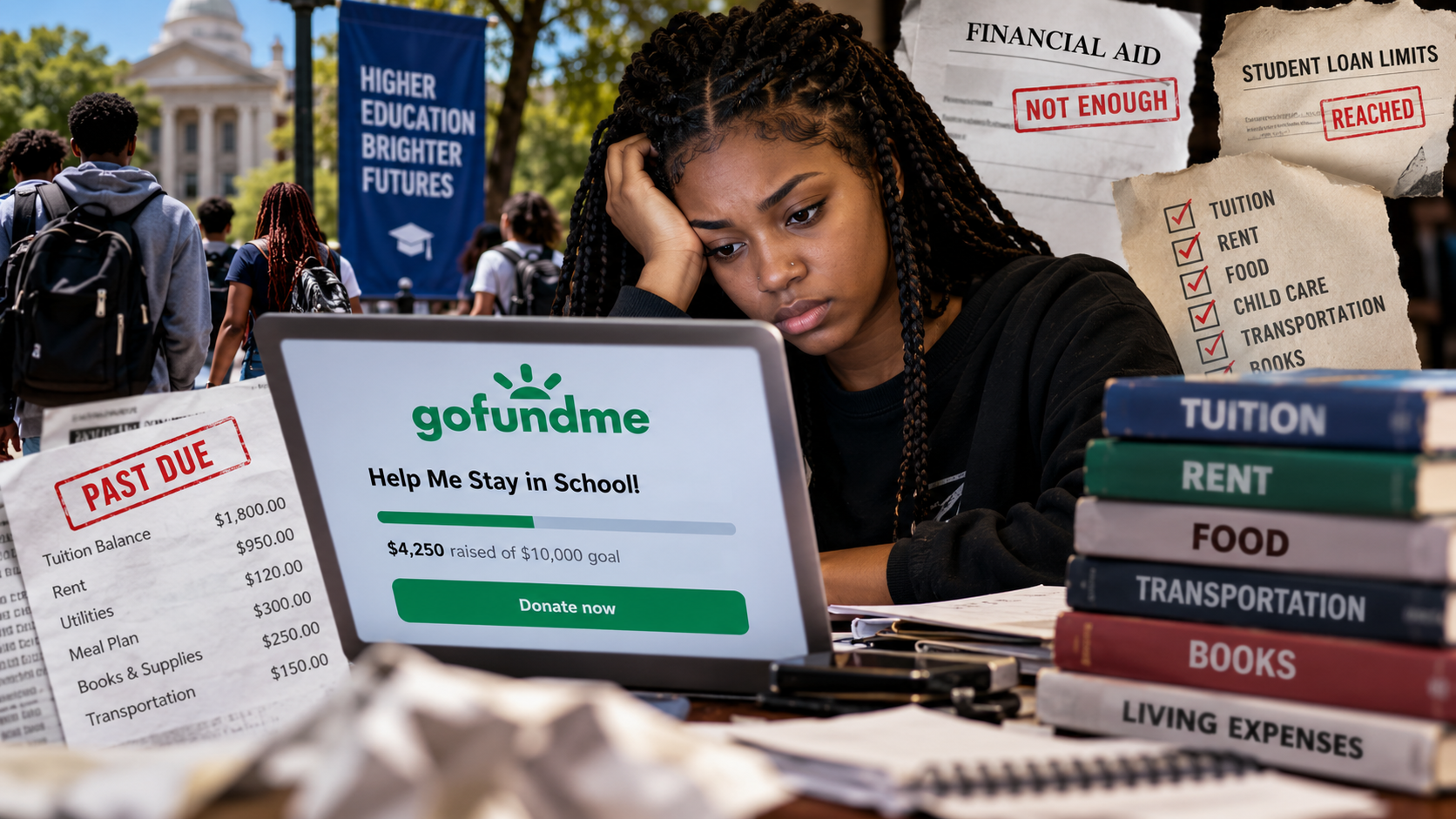
For a growing number of college students, paying for school now means asking strangers, classmates and social media followers to help close the gap. GoFundMe has seen an increase of more than 20 percent in fundraisers for tuition and related education expenses over the past year, according to data the crowdfunding company provided to Inside Higher Ed. The jump offers another window into an affordability problem that extends well beyond a college’s tuition bill.
Students are crowdfunding everything from tuition balances to housing and graduation expenses, according to Inside Higher Ed. Some campaigns followed job losses, medical bills, deaths in the family, or problems with expected financial aid. Others were launched because students simply could not cover what remained after their aid was applied.
Maximillian Matthews, a master’s student at North Carolina A&T State University, told Inside Higher Ed that he turned to GoFundMe after reaching a federal borrowing limit and facing an $1,800 gap.
“I noticed that people on social media were kind of going through the same thing that I was,” Matthews said. “I was noticing people reach out to the community for support, with paying not necessarily their tuition, but some people needed [help] paying for their cap and gowns [and] various expenses, and so I decided to do the same.”
The financial pressure is especially important because the sticker price of tuition tells only part of the story. According to College Board’s 2025 pricing data, average published tuition and fees for the 2025 to 2026 school year reached $11,950 for in-state students at public four-year universities and $45,000 at private nonprofit four-year schools.
Even students who receive enough grants to substantially reduce tuition can still face rent, food, transportation, books, technology, child care, and other expenses. College Board’s living expense guidance estimated a low 12-month living budget of $24,240 nationally for 2025 to 2026, rising to $26,150 for 2026 to 2027.
That helps explain why a student can have scholarships or financial aid and still end up asking for crowdfunding help.
The financial vulnerability is widespread. Trellis Strategies’ 2025 Student Financial Wellness Survey, which included more than 65,000 undergraduate students at 153 institutions, found that 54 percent of respondents would struggle to access $500 in cash or credit for an unexpected expense. Sixty-five percent reported running out of money at least once during 2025, while 54 percent experienced at least one form of basic needs insecurity.
Two-thirds of respondents were also working while attending college, according to Trellis Strategies, and one quarter of working students held more than one job.
For Black students, the affordability problem intersects with particularly high rates of basic needs insecurity. The Hope Center for Student Basic Needs at Temple University found that 59 percent of the 74,350 students in its 2023 to 2024 survey experienced food or housing insecurity. The center said those hardships were particularly prevalent among Black and Indigenous students, Pell Grant recipients, and other groups that already face barriers to affording higher education.
An analysis of federal data published by The Hope Center in 2026 found Black students had a 32.3 percent food insecurity rate and a 9.4 percent homelessness rate during the 2021 to 2022 academic year, nearly twice the corresponding rates among white students.
At the same time, emergency assistance is reaching far fewer students. A 2026 Hope Center analysis of Trellis survey data found the share of students receiving emergency aid dropped from 44 percent in fall 2021 to just 4 percent in fall 2025. The Hope Center noted that pandemic-era federal emergency assistance had expired, while many students also did not know whether emergency aid was available through their schools.
Federal borrowing rules are adding another layer of pressure for some graduate students. According to Federal Student Aid guidance, new borrowing limits that took effect July 1, 2026, eliminated Grad PLUS loans for affected new graduate and professional borrowers. Graduate students under the new rules generally face a $20,500 annual unsubsidized loan limit and $100,000 aggregate limit, while professional students have different limits.
Peter Granville, a senior fellow at the Century Foundation, told Inside Higher Ed that crowdfunding can appear when conventional options have already been exhausted.
“Even if someone has tapped into all of their federal student loans and they’ve done everything right in terms of federal financial aid, they may still have this gap that they’re hoping GoFundMe can try to fill,” Granville said. “In many circumstances, it could be people who have done everything they can loan-wise, and they truly are at the cliff of potentially having to drop out.”
Crowdfunding, however, does not guarantee that gap gets filled. Inside Higher Ed noted that research in other crowdfunding categories has found campaigns can favor people who already have access to wealthier social networks.
Jeremy Snyder, a Simon Fraser University professor who researches crowdfunding, warned Inside Higher Ed about treating online fundraising as an answer to a larger affordability problem.
“There is a danger as GoFundMe and crowdfunding become more normalized that it gets portrayed as a solution for the problem,” Snyder said.
For students staring at an approaching tuition deadline or rent payment, though, crowdfunding has one major advantage: speed.
“It’s a way for getting around these kinds of formal systems,” Paige Swanstein, co-founder and executive director of the Student Basic Needs Coalition, told Inside Higher Ed. “Basic needs issues aren’t waiting for a form to be approved.”
That may be the clearest explanation for the rise in college GoFundMe campaigns. The campaigns are not simply students asking the internet to pay their tuition. The data from Inside Higher Ed, Trellis Strategies, College Board, and the Hope Center points to students trying to cover financial gaps created by the combined cost of education and everyday survival, often when traditional sources of assistance cannot deliver enough money quickly enough.