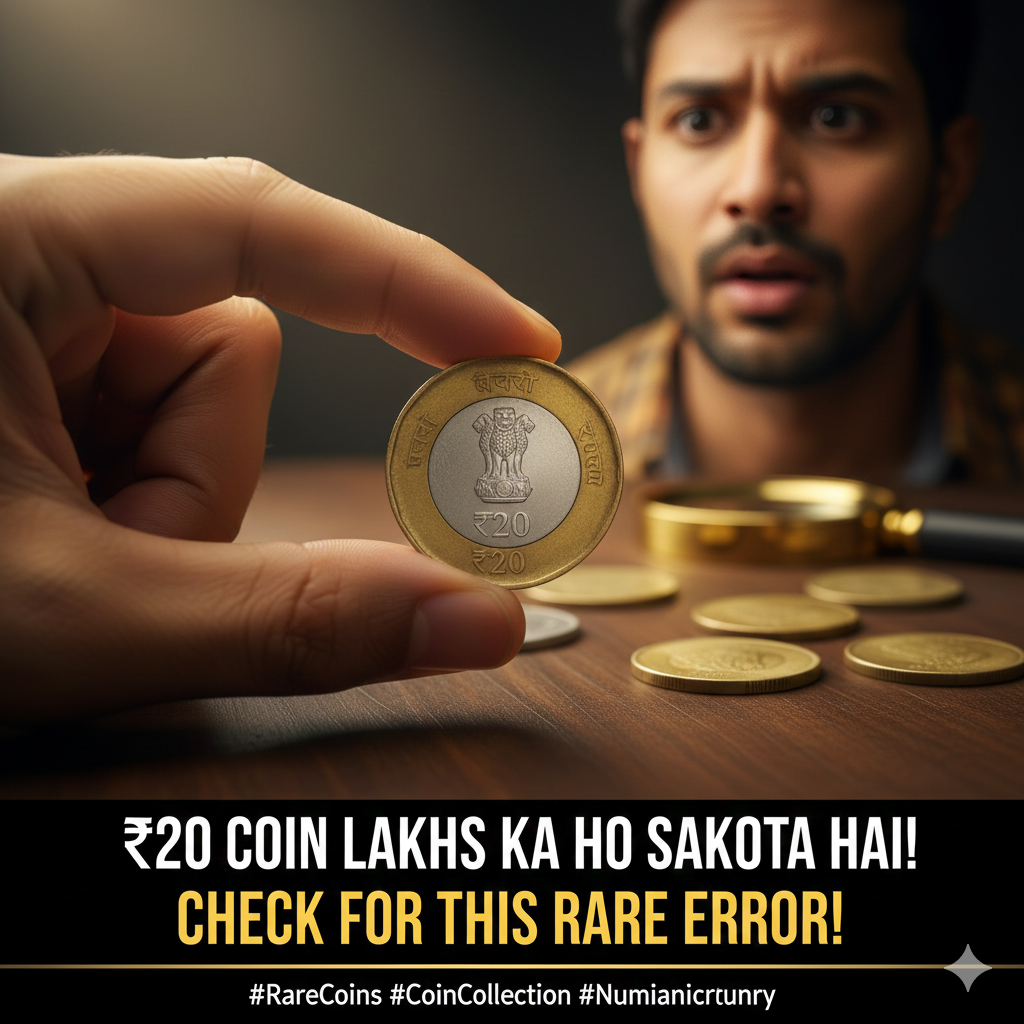
If You Have a ₹20 Coin, You Could Be Rich! Check For This Rare Error
Imagine reaching into your pocket, pulling out a seemingly ordinary ₹20 coin, and discovering it’s worth not ₹20, but potentially thousands, even lakhs, of rupees.
While most of us view loose change as mere pocket money, the world of numismatics (coin collecting) holds incredible secrets. Rare errors, unique mintages, or historical significance can transform common currency into a coveted collector’s item. And if you have an Indian ₹20 coin, specifically one with a little-known “rare error,” you might be holding a small fortune.
The Hunt for the Imperfect Perfection:
India introduced the new ₹20 coin in 2020, featuring a 12-edged dodecagonal shape, bi-metallic composition (outer ring of nickel brass and center of nickel silver), and a design celebrating the progress of the nation. While millions of these coins have been minted, a tiny fraction could possess a manufacturing anomaly that makes them incredibly valuable to collectors.
What Rare Error Should You Look For?
The most sought-after error that could turn your ₹20 coin into a treasure is typically a “Mule Error.” In coin collecting, a “Mule” refers to a coin struck with mismatched dies – meaning the obverse (front) and reverse (back) designs were not intended to be paired together. For the ₹20 coin, this could manifest as:
Wrong Die Combination:
An instance where the ₹20 coin’s obverse (Ashoka Pillar design) was accidentally struck with a die intended for a different denomination (e.g., a ₹10 coin’s obverse die) or vice-versa for the reverse (numerical 20 design). This is exceedingly rare but happens when wrong dies are inadvertently paired at the mint.
Off-Center Strike:
Though less valuable than a true Mule, a significantly off-center strike, where the design is noticeably misaligned or partially missing, can also fetch a premium, especially if it’s a dramatic error.
Die Rotation Error:
A less common error where one side of the coin is rotated at an unusual angle compared to the other side. You can check this by holding the coin at 12 o’clock and flipping it vertically; if the reverse is not perfectly aligned, you might have an error.
Why Are These So Valuable?
Minting errors are accidental by definition. When such a mistake occurs, and the coin somehow escapes quality control to enter circulation, it becomes extremely scarce. The fewer coins with a specific error, the higher their value to collectors who cherish uniqueness and rarity.
A well-documented Mule error on a relatively new coin like the ₹20 can command prices ranging from a few thousand rupees to potentially over ₹1 lakh, depending on its rarity and condition.
So, don’t dismiss that ₹20 coin in your wallet.
Take a moment to examine it closely. You might just be holding a valuable piece of history, an “imperfect perfection” that could make you surprisingly rich.
#RareCoins #IndianCoins #CoinCollecting #NumismaticsIndia #ErrorCoins #HiddenTreasure #20RupeeCoin #MuleCoin #CoinHunt