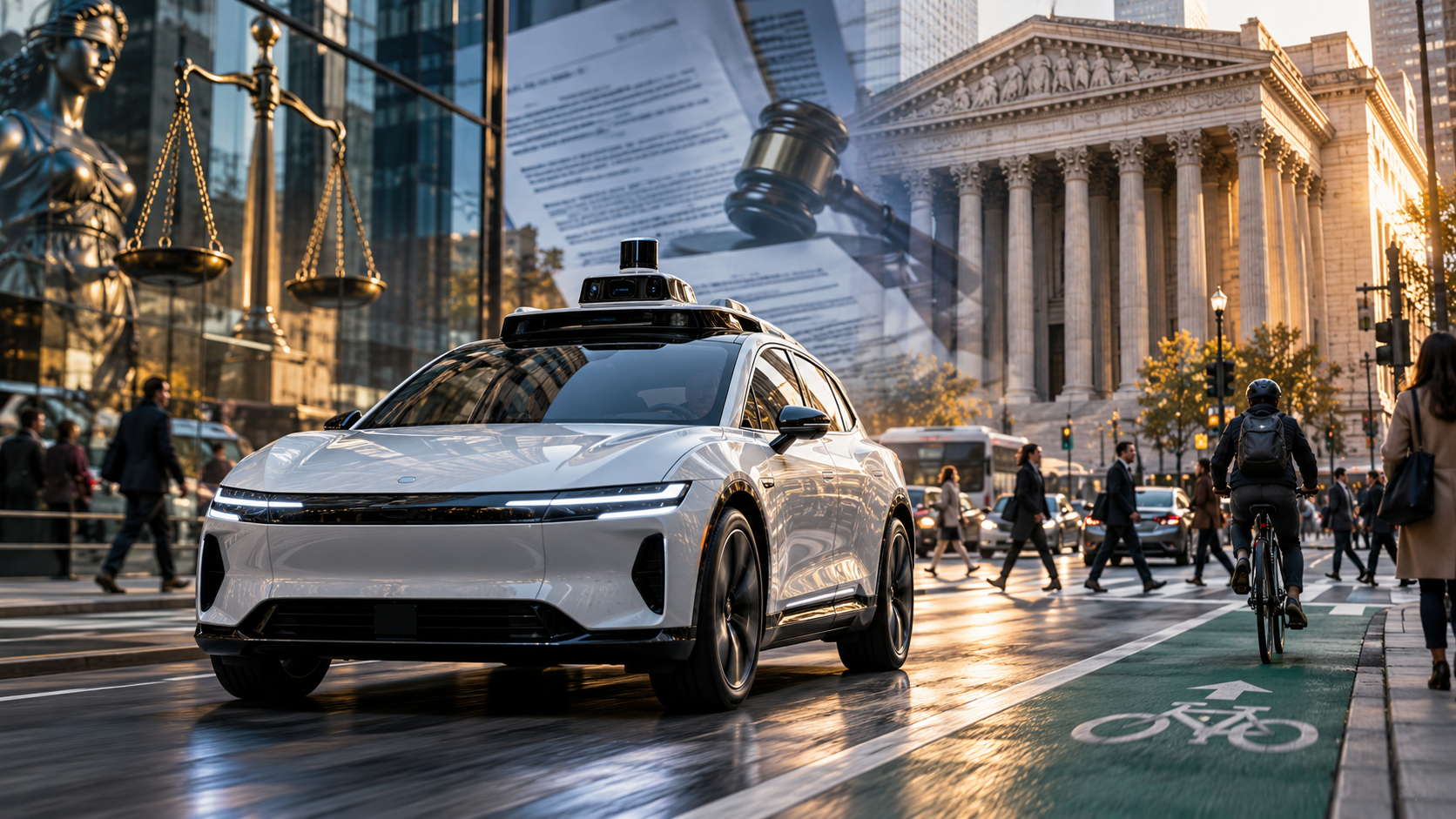
When a car has no human behind the wheel, one of the oldest questions after a crash suddenly becomes harder to answer: who is responsible? According to the National Highway Traffic Safety Administration, Level 4 automated vehicles can perform the entire driving task within certain operating areas without requiring a human driver to take control. As those vehicles increasingly share streets with passengers, cyclists and pedestrians, robotaxi lawsuits are beginning to test whether responsibility lands with the operator, the vehicle manufacturer, the software developer or some combination of all three.
One of the clearest examples involves Waymo and a San Francisco cyclist. According to a complaint filed in San Francisco Superior Court, Jenifer Hanki alleges she was riding in a marked bicycle lane on February 16, 2025, when a passenger in a fully autonomous Waymo opened a rear door directly into her path. Hanki claims a second driverless Waymo was simultaneously moving into the bicycle lane, leaving her with nowhere to safely maneuver. Her complaint says she struck the open door, was thrown from her bicycle, and collided with the second Waymo before being transported for emergency treatment.
The case goes beyond an allegation that a vehicle simply made a bad move. In Hanki’s complaint, she accuses Waymo and Alphabet of negligence and strict product liability, among other claims, and alleges that Waymo’s Safe Exit system failed to properly warn the passenger about the approaching cyclist. Those allegations have not been proven in court. Still, the theory behind the lawsuit shows why robotaxi lawsuits could look very different from traditional car accident cases. With no driver to blame for failing to check a mirror, plaintiffs can instead challenge how the technology was designed, how the vehicle chose where to stop, and whether the company’s safety systems performed as advertised.
Passengers are also testing another major issue: whether they can take autonomous vehicle companies before a jury at all. In July 2026, the California Court of Appeal’s published decision in Wilkins v. Cruise said Gino Wilkins sued Cruise and related General Motors entities after being injured while riding in an autonomous Cruise vehicle as a customer. Cruise argued that the terms Wilkins accepted while signing up for its app required disputes to be handled through arbitration. The appeals court agreed that the app provided sufficient notice of the arbitration provision and directed the lower court to grant the companies’ request to compel arbitration.
That ruling could become one of the most consequential developments in robotaxi lawsuits because it affects where those disputes are decided. Arbitration generally removes the case from a public jury trial and puts it before a private arbitrator. The Wilkins decision means the legal framework surrounding a robotaxi crash may begin forming before a passenger even enters the vehicle, when that person taps through an app’s terms of service.
Cruise has also faced the kind of catastrophic driverless crash that shows how liability can spread far beyond one civil claim. According to the U.S. Justice Department, a human-driven vehicle struck a pedestrian in San Francisco on October 2, 2023, throwing her into the path of a driverless Cruise vehicle. The Cruise ran over her, initially stopped, then moved again after its system failed to detect that she remained underneath it, dragging her more than 20 feet. The Washington Post later reported that Cruise reached a multimillion-dollar settlement with the woman, with Bloomberg reporting a payment between $8 million and $12 million.
The fallout did not stop with that settlement. NHTSA said Cruise agreed to pay a $1.5 million civil penalty after the agency determined that reports about the crash failed to disclose the vehicle’s post-crash movement. The Justice Department separately announced that Cruise admitted submitting a false report intended to influence a federal investigation and entered a deferred prosecution agreement that included a $500,000 criminal fine. The episode illustrates why robotaxi lawsuits are only one piece of the financial and legal exposure autonomous vehicle companies can face after a serious crash.
The industry’s liability questions started taking shape years before today’s commercial robotaxis. On March 18, 2018, an Uber automated test vehicle struck and killed Elaine Herzberg in Tempe, Arizona. According to the National Transportation Safety Board, the vehicle was being controlled by Uber’s developmental automated driving system, but a human safety operator was sitting in the driver’s seat. The NTSB ultimately found that the operator’s failure to monitor the roadway was the probable cause while also identifying Uber’s inadequate safety risk procedures and oversight as contributing factors.
Herzberg’s family never took Uber through a lengthy public civil trial. Reuters reported less than two weeks after the crash that Uber had reached an undisclosed settlement with Herzberg’s daughter and husband. That early resolution matters when examining robotaxi lawsuits today because some of the industry’s most important liability disputes have ended privately, leaving courts with fewer published decisions explaining how fault should be divided when automated technology is involved.
Tesla provides another important comparison, although its Autopilot cases should not be confused with fully driverless robotaxis. NHTSA classifies Level 2 systems as driver assistance technology that still requires the human driver to remain responsible and attentive. In a Florida case involving a 2019 crash, Reuters reported that a federal jury found Tesla partly responsible after a Model S operating with Autopilot struck two people, killing Naibel Benavides Leon and seriously injuring Dillon Angulo. The jury assigned Tesla 33 percent of the responsibility and returned damages that included $200 million in punitive damages. A federal judge upheld the $243 million verdict in February 2026, according to Reuters, while Tesla said it planned to appeal.
The financial stakes can reach investors too. Reuters reported that autonomous trucking company TuSimple agreed to a $189 million settlement in a shareholder lawsuit accusing the company and executives of overstating the safety of its technology and concealing other information. The allegations included safety concerns that gained new attention after a 2022 autonomous truck crash. TuSimple denied wrongdoing in agreeing to the settlement. The case was not a personal injury action, but it demonstrates how a crash involving autonomous technology can trigger liability far outside a traditional accident claim.
Taken together, these cases show a legal system still building the rules for vehicles that can operate without a person physically doing the driving. Some plaintiffs are targeting software and product design. Some injured passengers are confronting arbitration clauses. Some victims have reached confidential settlements before a jury could weigh responsibility, while crashes have also produced regulatory penalties, criminal consequences, and investor claims. As driverless vehicles expand into more cities, the next generation of robotaxi lawsuits may decide something bigger than who pays for one crash: they could determine how much legal responsibility a company assumes when it removes the human driver from the equation.