“I would absolutely do it again.”
Ten years on from making the gesture that catapulted him to iconic status, but which he believes led to his exile from the sport he loved, Colin Kaepernick insists he has no regrets.
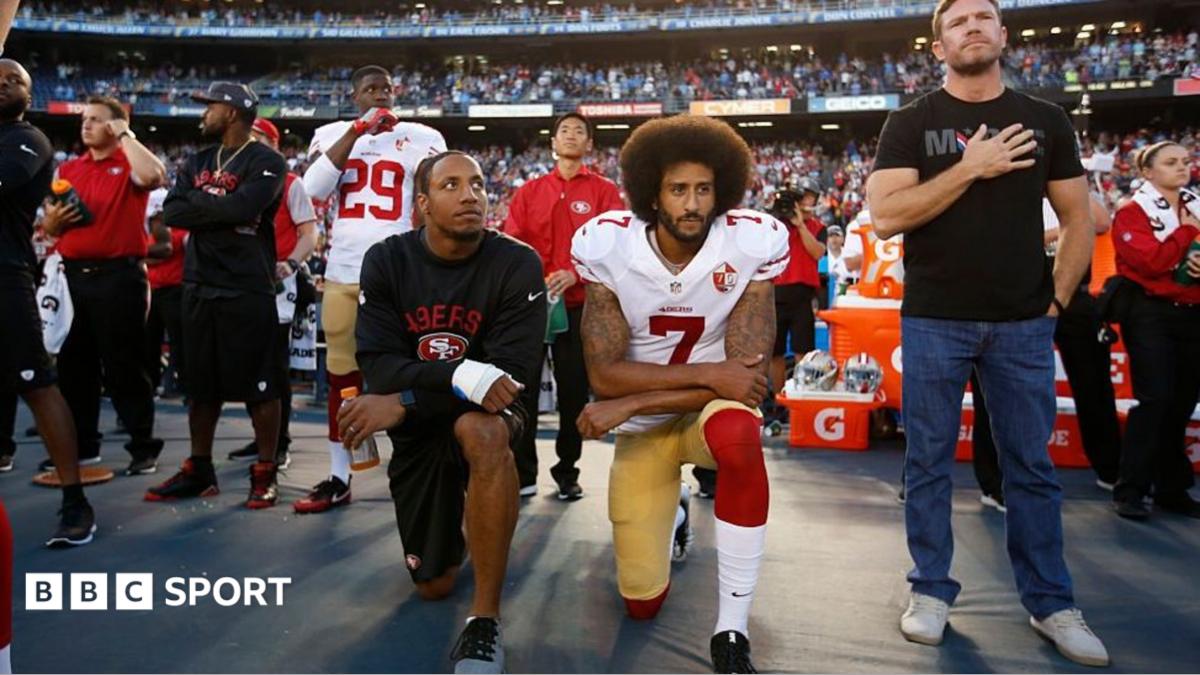
It was September 2016 when NFL star Kaepernick knelt during the US national anthem before a match as a peaceful protest against racial injustice and police brutality.
It proved both inspirational and divisive.
In his first interview with BBC Sport since then, Kaepernick reflects on his journey; his pride at seeing England footballers take the knee, athlete activism, the relationship between sport and politics, and the price he paid for being a figurehead for the civil rights movement.
“I knew the protest could potentially cost me my career,” he says. “History shows us…that is a reality for athletes.
“We also see this in broader movements, going well beyond costing someone their career, and costing people their lives. We see Malcolm X assassinated, we see MLK [Martin Luther King] assassinated, so the consequences are real.”
Having initially sat to protest against the plight of black people in the US, Kaepernick first knelt during the Star-Spangled Banner before his San Francisco 49ers team played a pre-season game. It was an act he would repeat before 11 regular-season contests that year.
At the time, he said he could not stand up for – and show pride in – a flag “for a country that oppresses black people and people of colour”, adding: “This is bigger than football and it would be selfish on my part to look the other way.”
His stance against racial inequality was seen as heroic by many, inspiring other NFL players to follow suit. But there was also condemnation from those who said it was disrespectful to the military.
Those dissenting voices included Donald Trump – then a presidential candidate.
Trump described the act as “a terrible thing” and unpatriotic. He even suggested Kaepernick should find another country to live in, adding players who refused to stand for the national anthem should be fired.
The NFL said it would fine teams whose players did not stand.
Kaepernick opted out of his contract with the 49ers in March 2017, though the club’s management later said he would have been released regardless.
Despite leading the 49ers to the 2013 Super Bowl, and throwing 16 touchdowns in his final season, one of the most talented quarterbacks in the sport never found a new team.
Speaking from New York, Kaepernick says he anticipated the reaction to taking the knee. “What I couldn’t have predicted was the people who would show up for me in significant ways, and also the people who worked against me and against the movement,” he adds.
Kaepernick eventually filed a grievance against NFL team owners, who he believed had conspired not to hire him because of his protests, reaching a financial settlement in 2019.
That year, the NFL arranged a private workout for Kaepernick, but he chose not to attend, instead holding his own session elsewhere to allow media to be present.
The NFL later admitted it was “wrong for not listening to players earlier”, and encouraged “all to speak out and peacefully protest”.