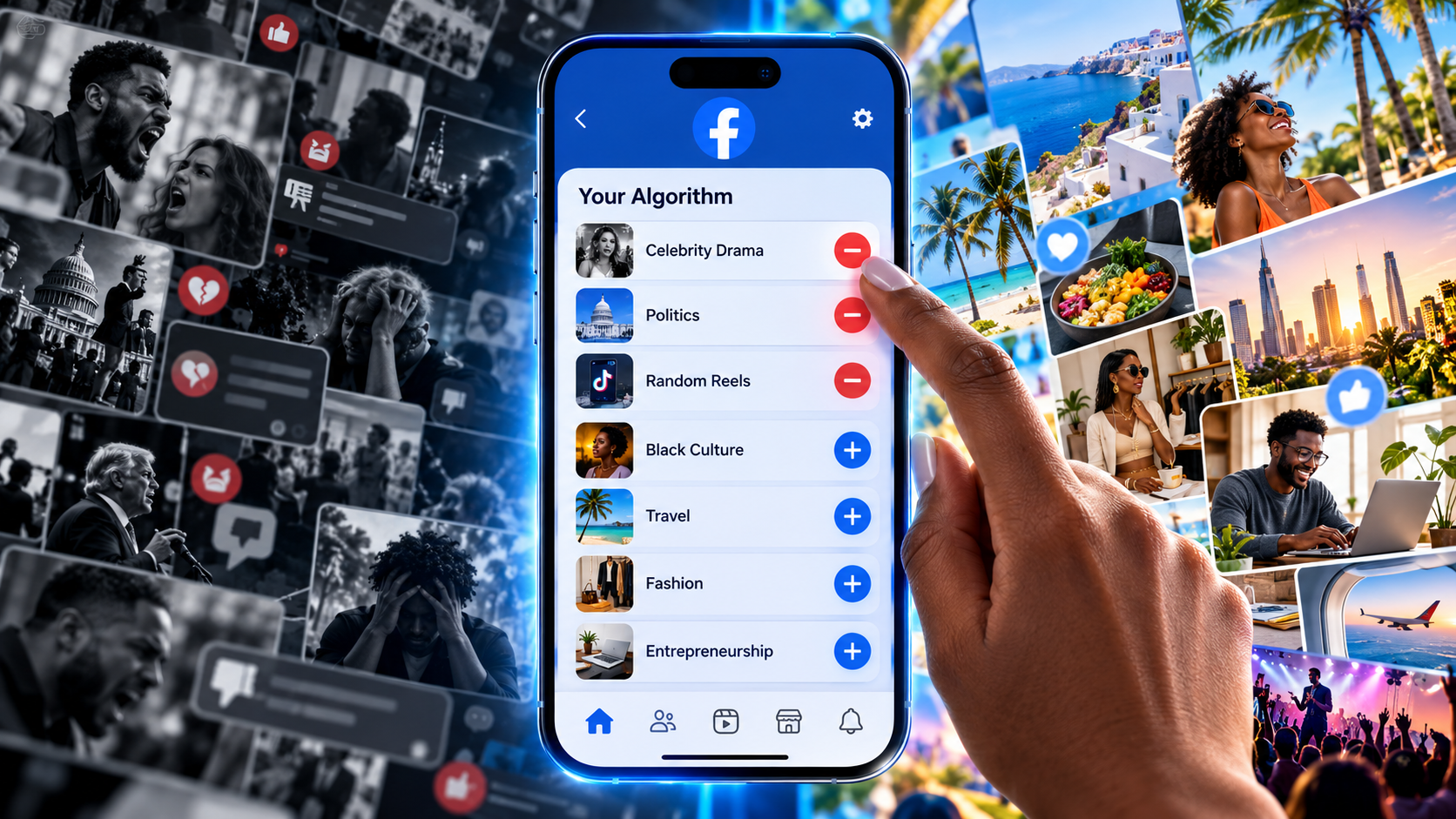
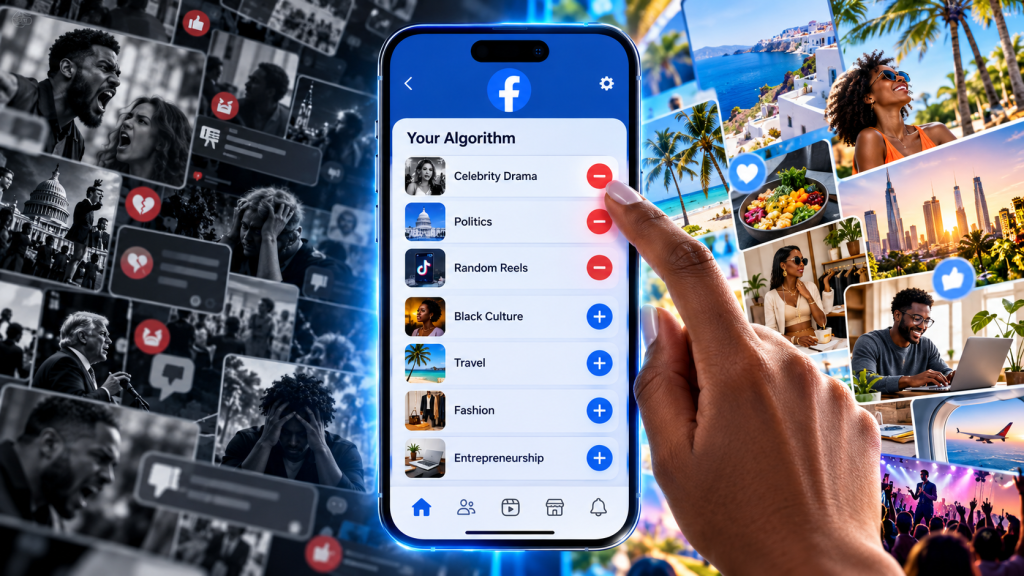
Facebook is making it easier to decide what shows up on your timeline instead of leaving everything up to an algorithm that thinks it knows you. Whether you’re tired of seeing random videos, unwanted celebrity drama, or the same type of posts repeatedly, a new feature will let you tell Facebook exactly what you want to see.
According to Meta’s October 13 announcement, Facebook is rolling out an artificial intelligence feature called “Your Algorithm,” giving users more influence over the posts and videos recommended in their Feed and Reels.
The biggest change is that you can now communicate your preferences in your own words. Rather than depending entirely on what you like, comment on, or watch, Facebook will allow you to directly explain which topics interest you and which ones don’t.
For example, someone interested in Black entertainment news, HBCU culture, fashion, entrepreneurship, and travel could request more recommendations related to those subjects. Meanwhile, users who are constantly seeing unwanted prank videos, political arguments, or repetitive relationship debates could tell Facebook they want less of that content.
These are examples of how people could use the new tool, not a guarantee that Facebook will completely eliminate unwanted topics.
Meta says users can open the three-dot menu on a Facebook post and select “Your Algorithm.” From there, they can add and manage topics they want to see in their Feed and Reels.
The feature gives users a more direct way to shape their recommendations without having to spend days interacting with similar posts, hoping Facebook eventually understands their interests.
Another important change involves the “Interested” and “Not interested” buttons.
According to The Verge’s reporting, Facebook users can access these feedback options through individual posts. Some posts may also display the buttons directly underneath the content.
Selecting “Interested” tells Facebook you want more similar recommendations, while “Not interested” signals that you would prefer to see less.
But Facebook is taking those responses further.
Meta says the platform may ask follow-up questions about why you liked or disliked something. Instead of simply rejecting a video, for example, you could explain that you’re interested in its subject but don’t want more content from that particular genre.
That additional context helps Facebook’s AI better understand your preferences rather than treating every interaction as a simple yes or no.
One of the most significant parts of the Facebook algorithm update is how quickly those preferences could affect your timeline.
In its announcement, Meta says the recommendation system can respond in real time, meaning users may notice adjustments during the same browsing session.
The technology uses large language models, the AI systems designed to understand everyday language, to interpret what users want.
Previously, Facebook’s recommendations relied heavily on behavioral signals, including likes, comments, watch history, and other interactions. Meta says those signals will continue influencing recommendations, but users’ written preferences will now become another important part of the process.
However, there’s a difference between influencing your Facebook algorithm and completely controlling it.
The new tool does not give users the ability to manually select every post that appears, guarantee that certain subjects never return, or completely disable Facebook’s recommendation system.
There are also other ways to customize your experience.
According to the Facebook Help Center, users can already hide individual posts, reduce content from certain people or Pages, and adjust their Feed preferences.
For people who would rather see updates from accounts they already follow, Facebook also offers the Feeds tab.
As explained in Meta’s introduction of the Feeds feature, that section prioritizes recent posts from friends, Pages, and groups rather than filling the experience with suggested content. Advertisements can still appear.
The newest feature builds on those existing options by allowing users to describe their interests directly instead of relying solely on preset settings.
Facebook also isn’t the first Meta platform to introduce this type of personalization.
Instagram previously introduced “Your Algorithm” and expanded its customization options in June 2026. Threads also introduced a similar feature called “Dear Algo,” allowing users to influence recommended content.
For everyday Facebook users, the biggest benefit is having more say in how their time online is spent. Someone who uses Facebook for business opportunities, community events, beauty inspiration, sports coverage, or entertainment news can now be more specific about what belongs on their timeline.
Meta describes the feature as rolling out, so users who don’t immediately see “Your Algorithm” in their menus may not have access yet. The company’s announcement did not provide a specific availability timeline for every account or region.
Ultimately, Facebook is still deciding how content gets ranked and recommended, but its newest update gives users a more direct opportunity to influence those decisions. Instead of letting every random click determine what comes next, people can finally tell the platform what they’re actually interested in seeing.