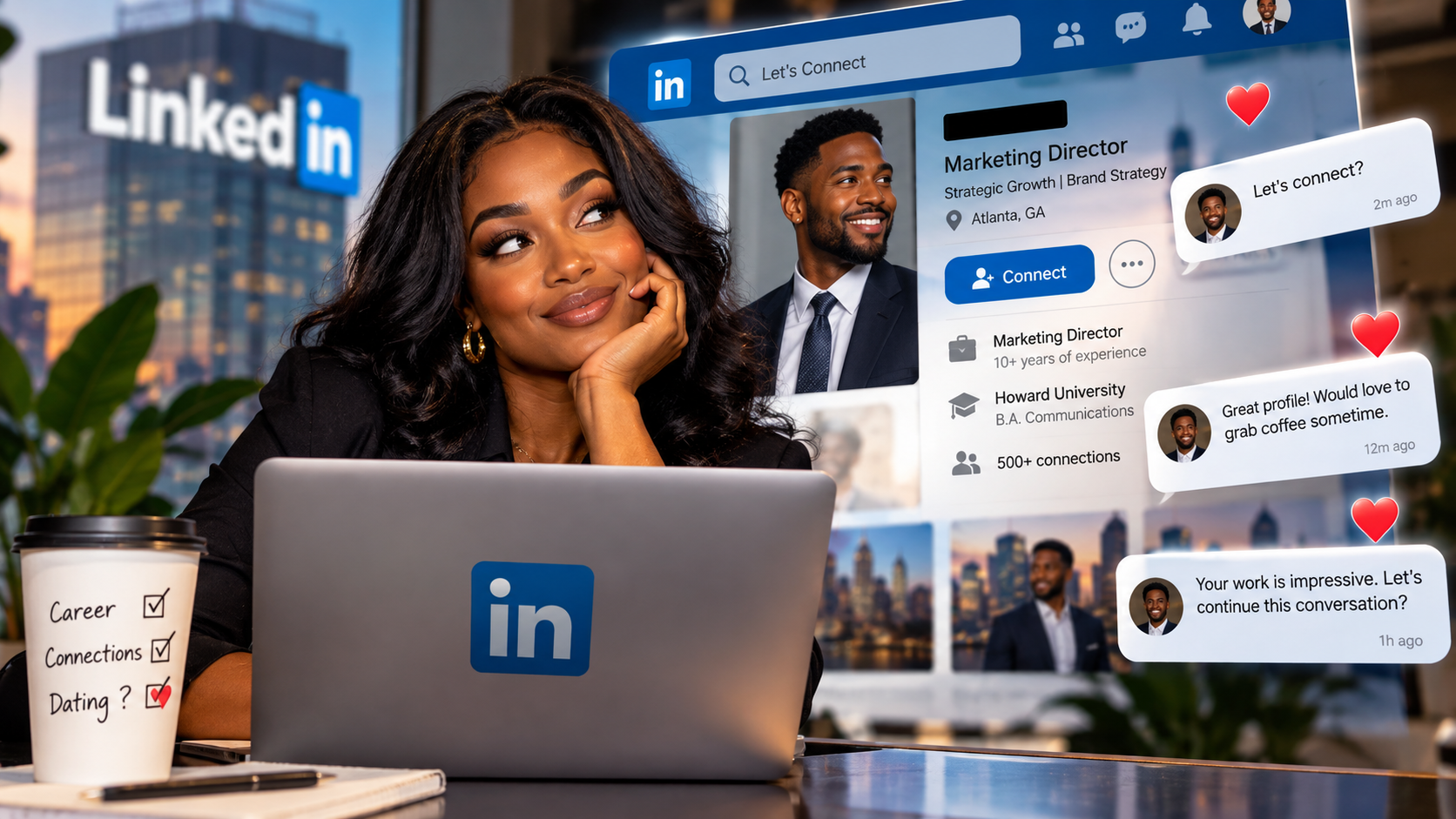
Your next LinkedIn connection request might have absolutely nothing to do with your career.
Singles are increasingly looking beyond traditional dating apps and finding potential romantic connections on LinkedIn, turning the professional networking platform into an unexpected place to shoot their shot. According to The Wall Street Journal, some users are approaching LinkedIn as another way to meet potential partners, despite the platform maintaining rules designed to keep romantic advances out of professional spaces.
One couple highlighted by the Journal shows exactly how blurry that line can get.
According to the Journal, Rachel Wong received a LinkedIn connection request from Sam Sawchuck, an alumnus of the company where she was working at the time. Sawchuck pointed out that the two likely shared mutual friends and colleagues and suggested meeting for coffee.
Then came the detail that changed the whole vibe.
Per the Journal, Sawchuck admitted that he had actually spotted Wong on Tinder first. Rather than making his approach there, he found her through LinkedIn. What could have easily become an awkward networking story went in a completely different direction. The Journal reports that Wong and Sawchuck developed a relationship and are now planning their wedding.
Their story may sound like a random romantic loophole, but data suggests LinkedIn dating is more common than people might admit publicly.
A Zety survey of 1,023 U.S. employees found that 22 percent had either sent or responded to a LinkedIn message with romantic intentions, according to Business Matters. The same survey found that 12 percent had entered a romantic relationship that started on LinkedIn, while 48 percent considered information on a LinkedIn profile more trustworthy than what they might find in a dating app bio.
That last number helps explain the appeal.
A dating profile can tell you somebody loves brunch, traveling, and Sunday football. LinkedIn can tell you where they went to school, where they work, how long they have been there, what industry they are in, and who you may know in common. There is usually a clear headshot attached, too. For singles already doing a little predate research, LinkedIn can start looking less like a job board and more like a verification tool.
The shift also arrives after years of complicated feelings surrounding traditional online dating.
In a national survey conducted in 2022, Pew Research Center found that 30 percent of U.S. adults had used a dating site or app. Among adults under 30, that number jumped to 53 percent. Pew also found that 10 percent of partnered adults said they met their current spouse or partner through a dating site or app.
Still, finding love online does not mean people are enjoying the process.
According to Pew Research Center, 88 percent of people who had recently used online dating said they had at least sometimes felt disappointed by people they encountered on the platforms. Women were also substantially more likely than men to report feeling overwhelmed by the number of messages they received.
That frustration creates an opening for unconventional forms of online dating. Instead of endlessly swiping through profiles specifically created to attract dates, some singles appear interested in spaces where people present another side of themselves.
LinkedIn dating comes with one major problem, though: LinkedIn does not want to be a dating app.
The company’s Professional Community Policies explicitly state, “LinkedIn is a professional networking platform, not a dating site.” The rules also tell members not to use the platform to pursue romantic connections or ask other members on romantic dates. LinkedIn prohibits unwanted expressions of attraction and sexual advances as well.
The company has taken steps to enforce those boundaries. In a 2022 LinkedIn safety announcement, the platform said it had updated policies and technology intended to protect members from harassment and unwanted romantic advances. LinkedIn said its messaging systems can detect potentially harmful messages and either send them to spam or hide them behind a warning.
The distinction between a consensual connection that becomes romantic and an unwanted advance is important. LinkedIn dating might sound funny when the outcome is a wedding, but receiving romantic messages in a space someone uses strictly for employment, business development, or professional networking can feel invasive.
That tension becomes even more significant because LinkedIn profiles are built for visibility. Users routinely list their employer, educational history, city, professional accomplishments, and network connections. The information that makes LinkedIn attractive to recruiters can also give a stranger significantly more information about someone than a typical dating profile provides.
Still, people have always found romance in places that were never specifically designed for dating. Couples meet at work, school, church, conferences, gyms, and through mutual friends. Social media expanded that list years ago. Instagram DMs have launched plenty of relationships without Instagram ever branding itself as a dating service.
LinkedIn dating may simply be another version of that behavior, with a résumé attached.
There is also a little irony involved. Dating apps spend enormous energy helping users establish credibility and figure out whether matches are who they claim to be. LinkedIn was built around professional identity, employment history, and real-world networks from the beginning. Those features were designed for business, but some singles clearly see another use for them.
That does not mean every “Let’s connect” notification is secretly somebody trying to take you to dinner. Most people are still on LinkedIn to find jobs, recruit employees, build businesses, and maintain professional relationships. LinkedIn itself remains clear about what the platform is supposed to be.
But as singles grow tired of swiping and start looking for different ways to meet people, the separation between professional networking and personal connection is getting a little less clean. For some users, the résumé apparently comes first, and the date comes later.