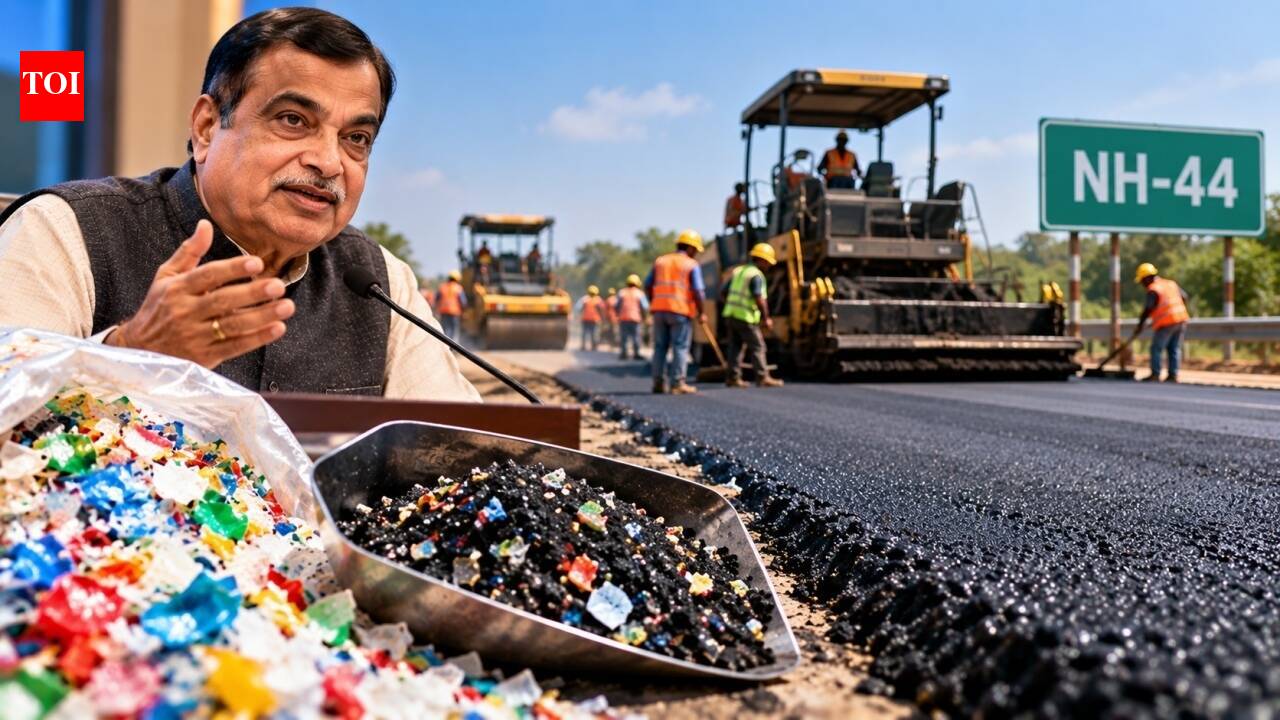
In a first for the road sector, the Nitin Gadkari-led Road Transport Ministry has used waste plastic in a wet mix with bitumen to construct a bituminous stretch of a national highway. The initiative could help reduce the country’s dependence on imported bitumen while also providing a way to tackle the growing volume of plastic waste.A pilot test section was laid recently along the main carriageway of NH-44 in Jhansi. Officials involved in the pilot said the technology could lower the consumption of conventional bitumen by around 4%, reducing demand for a material that India largely imports to meet its domestic needs. They also said the modified bitumen could be about 20% cheaper than conventional bitumen.
The process
The waste plastic wet-process technology used to produce premium-quality Waste Plastic Modified Bitumen (W-PMB 76-10) was developed by IIT (BHU), Varanasi, as part of a research programme funded by the ministry of road transport and highways.Officials said IIT (BHU) will monitor the pilot stretch to evaluate its long-term engineering performance and determine its suitability for use in the field.India produces around 25,000 tonnes of plastic waste every day. Previously, the use of waste plastic in road construction was limited to a dry-mix process, in which the plastic was combined with aggregates during the laying of the bituminous layer.Under the new process, treated waste plastic is blended directly with bitumen before the material is laid. This makes the Jhansi stretch the first such pilot project on a national highway.According to officials, the technology could provide several benefits. These include the value-added use of waste plastic through a scientifically controlled process, as well as better resistance to rutting in bituminous mixes exposed to high temperatures and heavy axle loads.The technology has also recently received a patent. The process uses low-density polyethylene (LDPE), a soft, flexible and lightweight thermoplastic derived from petroleum. The LDPE used includes discarded irrigation pipes, waste files and plastic folders. Local recyclers and MSMEs have helped process the material, creating an opportunity to link local waste recycling with infrastructure development.“Laboratory evaluations have shown that LDPE-modified bitumen provides better resistance to moisture damage and greater resistance to rutting at high temperatures. The modified binder increases the stiffness and high-temperature performance of asphalt, helping pavements withstand permanent deformation under heavy traffic loads and extreme temperatures,” an official said.
Sustainable alternatives in every sector
India has been looking at sustainable alternatives across infrastructure and transportation sectors.After the introduction of E20 petrol for cars, attention is now turning towards flex-fuel engines capable of running completely on ethanol, or E100. Road Transport and Highways Minister Nitin Gadkari recently highlighted ethanol’s potential to increase farmers’ earnings while reducing India’s dependence on imported petroleum, as he called for wider adoption of alternative fuels and cleaner public transport.Gadkari made the remarks at an event where he, along with Madhya Pradesh Chief Minister Mohan Yadav, inaugurated the state’s new public bus service.“Today, the farmer is not only our ‘anna data’ (food provider) but also our ‘urja data’ (energy provider),” Gadkari said.He said the expansion of ethanol production had already benefited farmers, citing the increase in maize prices from around Rs 1,200 per quintal to Rs 2,600 per quintal after ethanol production grew.“This is the meaning of swadeshi, self-reliance and independence,” he said.According to a PTI report, Gadkari said flex-fuel engines designed to run fully on ethanol were under development and vehicles using the technology would be introduced.He said moving towards cleaner fuels could help lower pollution as well as reduce India’s fuel import dependence, while maintaining safety.Gadkari said India currently imports petroleum worth around Rs 22 lakh crore, highlighting the need to reduce dependence on overseas fuel supplies by expanding the use of ethanol, electricity, hydrogen and other alternative energy sources.